
 Anchor Alarm
Captain — your profile
The Captain's Dashboard is your account home. It looks different
depending on whether you are signed in.
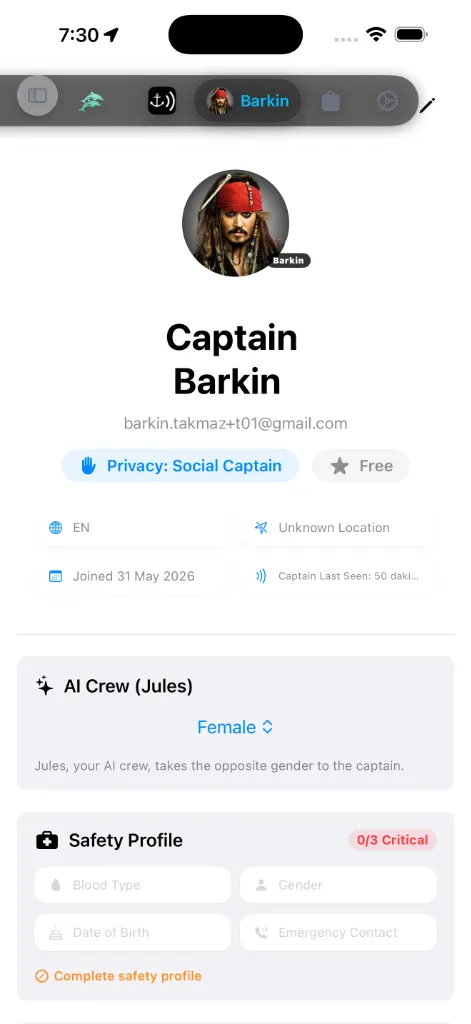
Signed in
When you are signed in the dashboard shows:
four info capsules below it: your country, your last known
place (a town or coast name, not raw coordinates — shown only while
your privacy level is Social Captain, otherwise it reads *Location
private*), the month you joined, and when you were last seen.
Routes and Anchorages. Each is a lifetime total with a small
twelve-month trend line and, once you have a full season behind you, how
it compares with the year before. The counts appear only after you have
recorded something; a brand-new account sees nothing rather than three
zeroes. See [Your record](#your-record).
number costs you. See [Your vessel's specs](#vessel-specs).
open Privacy Settings and change who can see you.
when it renews. Tap it to open the premium Licenses Ledger.
the only preference exposed here. Units and theme live in
Settings, not on this dashboard.
To sign out, tap the pencil to open Edit Profile — the Sign
Out button is at the bottom of that screen. There is no sign-out
control on the main dashboard.
Your record
The three counts read from what you have actually recorded:
counts here, not as a passage.
The trend line under each is the last twelve months, oldest on the left,
this month on the right. The percentage compares those twelve months with
the twelve before them — a whole year against a whole year, because
sailing is seasonal and comparing one month with the last would report a
collapse every autumn. In your first season there is nothing honest to
compare against, so a dash appears instead of a number.
The totals are lifetime figures and never shrink: an old passage still
counts even after it has scrolled off the trend line.
Your vessel's specs
The Vessel card shows the numbers the app uses to plan for your boat:
draft, air draft, length overall, beam, average speed and fuel burn. It
is a read-only view — tap Edit vessel specs to change them.
Average speed is measured, not guessed. Once you have completed three
passages the figure is your own average over the last twelve, and the
card says measured beneath it. Before that it shows the cruise speed
you set, marked you set this, or a default for your hull type. This is
the speed every ETA in the app starts from — see
A missing number says what it costs. Anything unset reads Not set
in amber, with a line underneath explaining what stops working. Without
air draft, bridges and power lines are not checked on your routes.
Without fuel burn, a passage cannot estimate its fuel cost. Nothing else
about the app changes; those specific checks simply do not run.
Licenses Ledger (App Store Accounting)
Tapping the Subscription Status capsule on your profile card immediately launches the Licenses Ledger (SubscriptionLedgerSheet). This acts as the official visual accounting dashboard for your active App Store licenses, direct region purchases, and complimentary chart pack slot allocations.
If you hold both a paid plan and a separately-purchased Real-Time
Remote subscription, a Real-Time Remote also active ·
line appears under the plan name — Remote has its own renewal cycle, so the
ledger states it explicitly rather than folding it into the plan's date.
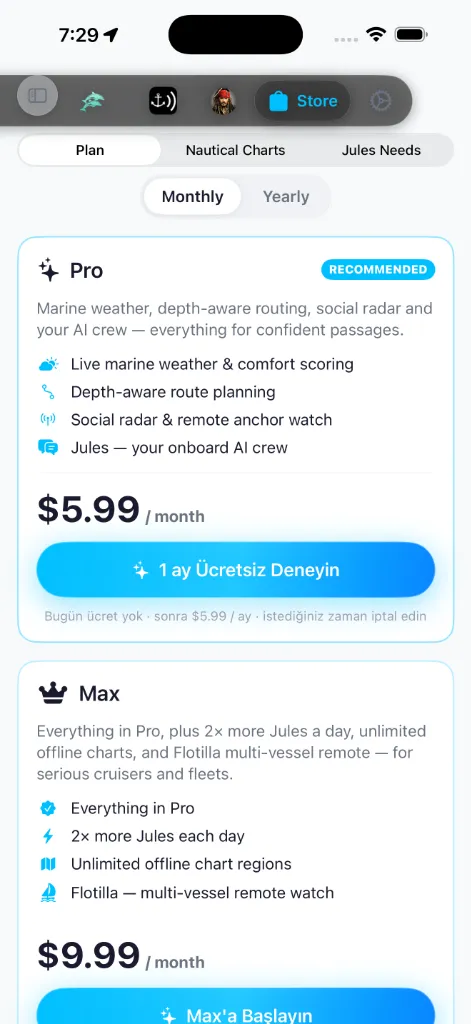
Complimentary Chart Pack Slots
Premium memberships grant complimentary, permanent slot allocations for
high-resolution chart regions:
* AnchorQueen Free: 0 complimentary slots.
* AnchorQueen Pro: 3 complimentary slots, chosen one at a time.
* AnchorQueen Max: unlimited — every region is included, so the ledger
shows a coverage card instead of a slot roster; nothing to claim or
choose between.
* Real-Time Remote (standalone, not a plan): 1 complimentary slot
while the subscription is active.
If your account is grandfathered (an early lifetime account), the
ledger labels it AnchorQueen Grandmaster with *Grandfathered Lifetime
Access* and a crown. This is not a fourth tier you can buy — it is a badge
for legacy lifetime accounts, with Max-level capabilities.
Slot Licensing States
Each slot in the roster dynamically tracks the status of its bound license:
* 🟢 Active (Expires : The region is fully active with offline capabilities and passage planning.
🟡 Expired · Routing Disabled: The region's subscription has expired. Offline viewing of vector charts remains fully active, but advanced Hybrid A-APF passage routing within the region is locked.
* 🔴 Expired · Locked: The region's slot is expired and offline downloading is locked.
The Captain's Safe Data Guarantee
Signed out
When you are not signed in the tab is a sign-in screen:
The same screen appears wherever you reach your profile from — the
Captain tab, or the captain card at the top of the
sidebar, which reads Sign In while you
are signed out. Opened from the sidebar it arrives as a sheet with a ✕
in the top-right corner; close it to go back to the chart. Once you sign in,
the same sheet becomes your dashboard.
You need to be signed in to use Jules and the
AI Crew (Jules)
Below your profile card is an AI Crew (Jules) card with a single control:
your AI marine officer, takes the opposite gender to the captain,
and the line under the picker states the outcome plainly (*Jules will
speak as a woman / as a man). (This setting moved here from the Safe Anchor
settings.)*
This is separate from the Gender field in the [Safety Profile](#safety-profile)
below — that one is a search-and-rescue datum, this one only shapes Jules.
Safety Profile
The dashboard shows a Safety Profile card (SOLAS SAR / ISAF) — the
information rescue services ask for first. The card's header carries a
readiness badge: it reads SAR Ready (green) once all three
critical fields are filled, or N/3 Critical (orange / red) while any
are missing. The three critical fields are blood type, the
emergency-contact name, and your date of birth. While the badge
is below 3/3, a Complete safety profile prompt nudges you to fill in
the rest.
Tap the pencil to edit these details in Edit Profile:
This is the SAR datum — distinct from the three-option Jules gender
[above](#ai-crew).
emergency contact during a distress event. The dashboard card echoes
this as Jules can notify this contact once a contact is set.
Everything here stays on your device and in your synced account; it is
shared only when you trigger a distress alert.
My Vessels
The My Vessels card manages your fleet and which boat is currently
active.
editor.
Drag a vessel from the fleet roster onto it to make that boat the
active one. The box highlights green while you drag over it. The active
vessel is remembered between launches.
drop zone. No vessels registered yet shows until you add your first.
end of the row and choose Edit. Long-press the row for the same
menu.
on the active vessel it reads Remove. Swiping the row left still
reveals the same two buttons as a shortcut. Deleting asks you to
confirm and cannot be undone; deleting the active vessel clears the
drop zone.
Document Vault
A private store for your ship's papers — reached from the Captain tab.
Upload ICC, RYA, STCW certificates, insurance policies, vessel
registration, and crew manifests, sorted into folders.
that turns orange near full.
progress percentage.
delete existing documents to free space or choose a smaller file.
Share the App
At the bottom of the dashboard a Share the App button opens the system
share sheet so you can pass AnchorQueen on to crewmates and fellow
skippers.
In Edit Profile
Tap the pencil to reach Edit Profile. Beyond display name, language,
the Safety Profile, and Sign Out, it has:
partners). Off by default.
[Delete your account](#delete-account).
Delete your account
You can permanently delete your AnchorQueen account from inside the app.
Open Edit Profile (the pencil on the Captain tab) and tap Delete
Account, then confirm.
This permanently removes your account and the data tied to it — your
captain profile, boats, saved routes, marks, and voyage data — and cannot
be undone. Deletion runs on our servers, so the account is fully removed,
not just signed out, and you are returned to the sign-in screen.
Two things it does not touch:
not cancelled by deleting your account. Manage or cancel it in
Settings › Apple ID › Subscriptions on your device.
anonymous seabed reports) and legally required accounting records are
kept, with no link back to you once the account is gone.
If deletion can't complete — usually a connection problem — nothing is
deleted and you can try again.
What signing in does
Signing in connects your device to the AnchorQueen cloud so that:
Your sailing data on the chart and in Capt's Notebook stays on the device
unless you choose to sync.
If something goes wrong
connection.
in the Store.
Settings and make sure they agree.